God, Guts, and Guns, Part 4: Where Do We Go From Here?

This post is part of a series. You can read part 1 hereread part 2 here, and read part 3 here.

It’s not lost on me that when I talk about leaving evangelicalism, I sound like someone who has left a cult, and I wonder if the only difference between a religion and a religious cult is the membership size, because I know what world I escaped. Not just the world I described in this series, full of gun-toting children and rampant racism, but a world in constant fear of whatever enemy they’ve made up this time.

Meme from Twitter. @CrappyFumes writes: Evangelicals don’t think life is supposed to be good. They think life on earth is supposed to be a crucible that tests if you’re fit for heaven. If evangelicals take over society the quality of life for everyone is going to steeply decline. Count on it. @CrappyFumes replies to own tweet: Like if you think our society is obsessed with punishment now…these people literally think that death for a believer is a merciful release from a world of earthly sin. They think death should be looked forward to. They don’t want to improve society. They want apocalypse.

A world of panic: I was too young and dressed in pink to be targeted during the height of the Satanic Panic in the 1980s, but I certainly knew whom and what I was supposed to be afraid of. I recall a time when my youth group invited a “former Satanist” to come and tell us literal horror stories about demonic possession through the powers of heavy metal music and Dungeons & Dragons. (That’s right kids, season four of Stranger Things hits differently if you remember the Satanic Panic.) Looking back, as someone who has regained her senses and no longer believes in demonic possession, where the hell did my youth group leader find this guy? Was he vetted at all? Would it have mattered?

A world of censorship: There was always someone on me about the types of fiction I preferred. I’ll never forget the time a youth leader (who was also the director of the summer church camp I attended) stood in our kitchen and warned my mother about the fantasy novels I enjoyed because they were put out by TSR, the same publishers as the Dungeon Master’s Guides. In the director’s mind, these books were the path to Hell and my mother should take them and burn them right away, lest I burn later. I remember how my stomach dropped, because those fantasy novels did more to guide me and stop me from succumbing to my own depression and anxiety than the Bible ever did. To my mother’s credit, those fantasy novels still grace my shelves. Burning books never sat well with my mom—and she didn’t like being told what to do in her own home either.

A world of purity culture: Put simply, purity culture sucks for women and girls. Outside of being made to believe that our value is intrinsically linked to the social construct of virginity, we are also held responsible for the thoughts and actions of pubescent boys (and grown men). We are taught to embrace a “Modest is hottest” dress code to signal to worthy young men that we are worthy young women, but more than that, to protect men’s minds from turning to lustful thoughts, thus protecting ourselves. It’s the open door to full victim blaming when someone does hurt us. “What did you expect when you’re dressed like that?”

Of course, boys are instructed to keep themselves pure as well, but there’s always been a bit of a *wink, nudge* to it. Straight, cisgender boys can’t get pregnant, and since (outside of STIs and STDs) nature doesn’t do much to hold boys accountable, evangelical Christians don’t either.

Which leads to women and girls not having any rights or resources left at all.

I am so grateful I got out. But now, having put it all behind me, my biggest fear is that I’ll be forced back into that cult. This time, my fear is justified and based in reality.

Anyone in the United States has a right to their religion and the freedom to practice it. However, those of us who don’t share those beliefs should have freedom from those beliefs. Meanwhile, the evangelical goal is to rebuild the government in the church’s image, and with the Supreme Court overturning Roe vs. Wade, and siding with performative prayer on the football field of a public school, it seems that they’re winning.

We were always implored to pray for our leaders and representatives. There was often talk during election seasons about Christian candidates and who stood for our values. But the final straw for my mother came in 2004 when the politics came directly from the pulpit and the pastor told the congregation how they should vote. I had left the church by then, but I recall how upset my mother was when she told me how the pastor said that Christian values should be the priority when voting. That in God’s eyes, morality was more important than the economy, foreign affairs, climate, or anything else, and from that perspective, “George Bush was God’s candidate.” That was it for my mom. She got out, too.

So, when you see some clown saying outrageous things, like how we should rethink the separation of church and state or how this is a Christian nation, and think it’s just for clicks or for show, it’s not. Know that they’re pandering to a base that is very real, very serious, and a lot larger than you think (approximately 90-100 million people in the United States identify as evangelical Protestants), and their radical messages have been pumping through church loudspeakers for decades. If there’s any point I want to stress, it’s that the “weirdo fringe” isn’t that fringe, and they’ve been planning and preparing for a long time.
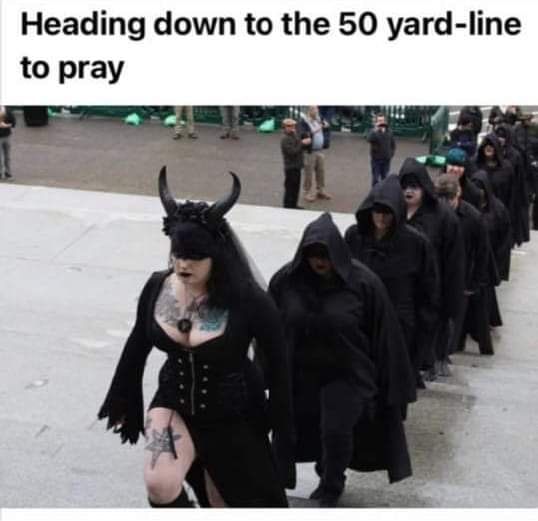
People with black hair, black clothes, and tattoos walking single file up concrete steps. Text reads: Heading down to the 50-yard line to pray.

I see variants of the meme shared here. Black-haired folks with tattoos and black clothes, presumably Satanists, marching to the 50-yard line to say their own prayers. I have a laugh and throw the horns and hail Satan because—to be clear—I don’t actually believe in Satan anymore. But then it occurs to me, accompanied by a horrible chill that rolls up my spine, back down, and settles in my gut: evangelical Christians do believe in a literal Satan, and that a literal war between Good and Evil is coming. To some degree, we’re playing into their hands when we share these memes. Evangelical Christians relish the idea that they might be proven right in a field of battle, but even more? That those of us who they believe to be wrong will be punished, doomed to burn for eternity in the Lake of Fire, and that they will have had a hand in it. The cruelty is the point.

Still, what option do we have but to push back? No one wants to live in a country run on religious ideals. We’ve been told to fear those countries often enough by the very same people who would turn the United States into one. I believe there’s something in The Much-thumped Book about a person who can’t see the plank in their own eye but criticizes someone for the speck in theirs (Matthew 7:5). Outside of speaking out and voting accordingly (blue), one of my favorite means of pushing back is to file a complaint with the IRS to revoke the tax-exempt status of any church engaging in political activity. This is a capitalist society; hurting their wallet hurts their power.

As for me personally? I reflect on how I’m no longer comforted by a cross on the wall of a hospital room. For me, the cross doesn’t represent Christ’s sacrifice, but rather the worst times of my life. I don’t join groups because I don’t trust them. I think about how the first time I ever really felt peace was the first time I considered that it might all be bullshit, and if I felt relieved by that rather than afraid, then what did that say about my belief? I chuckle when I think that maybe that youth leader/camp director was actually kind of right about my path to the dark side as a purveyor of some of the same creepy stories I’d been warned against and the author of this piece, though it wasn’t really the fantasy novels or the comic books or the secular music that did it because…

I also can’t stop thinking about a sermon that same youth leader/camp director once gave, feeding us the poisonous evangelical lie that we will be held responsible for the souls we didn’t save. I wonder what awaits the people whose actions are directly responsible for turning people away from Christ.
I’m Child Free by Choice and I Finally Got My Tubes Tied

Actually, I had my fallopian tubes removed altogether but we’ll get to the specifics later. What’s important right now is that finally, after more than a decade, after being turned away twice, after enduring the endless condescending comments on the matter, I’ve been allowed to make my own decision about my own body and reproductive choices and have myself permanently sterilized.

My journey to sterilization started in Pennsylvania, which is important to note because in addition to spanning many years, this journey crossed state lines. I acknowledge that getting a tubal ligation (or in my case, a bilateral salpingectomy) was easier here in Washington state than it might have been in some other parts of the country. I urge you to look into the laws in your state and talk to your doctor regarding facility policy and the law.

I knew at a young age that motherhood wasn’t for me. Sure, I had hypothetical children, but they only got mentioned when declaring how differently I would do things if and when I had kids. Sometimes, I’d read a book or see a movie and there’d be some kick-ass character with a cool name and I’d think, Hey, that’s a really cool name. I’d totally name my kid *Blah* but that’s about as far as any aspirations of motherhood went. So, in my early twenties (in Pennsylvania), I asked my doctor about tubal ligation. Her response was that I was too young to know for sure that I didn’t want to be a mother, that they didn’t ever sterilize women my age unless they’d already had a couple of children, and that I needed to wait until I was at least 25 to have this discussion. The first time around, I could see my doctor’s point. I was 21 or 22 at most and in the height of my party days, not my serious thought and knowing what the hell I wanted from life days. At the time, even I conceded that maybe waiting was best.

Fast forward a handful of years—we can skip over the times I white-knuckled it, begging the heavens for my period to start any time it was so much as a second late. I’d turned 25 in December. January found me back at the doctor’s office asking about tubal ligation. I knew with certainty that I didn’t want to be a mom, but my doctor had other ideas. She looked over my chart, confirming that I had not yet had any children. “You’re single?” she made her statement a question. I confirmed that I was, in fact, single. If anything, I thought that would help my case, but then she looked at me and said the words I’ll never forget: “What if you meet a man who wants kids?”

An educated, successful woman had just let those words come out of her mouth. I was dumbfounded by her betrayal. I’d already ended a handful of potential relationships because the men in question wanted to be fathers someday and it hurt to break up, but by goddess I did it because I knew for damn sure I didn’t want children. How dare this woman not take my word for it!

I don’t remember what I ended up saying to her when she told me to ask again at 30. I just remember feeling betrayed, angry, and helpless. I knew in that moment that I absolutely despised her. I know that still, in more private forums, I speak of her with all the spite I can spit.

I’d met my now husband by 30 and he was more than willing to get a vasectomy after we got married and were certain that we weren’t having children. (I told him that if he was marrying me with hopes that I would change my mind about motherhood, he shouldn’t marry me.) While his offer to get a vasectomy was sweet, it always stuck in my craw that he had to make it at all. Yeah, I get that vasectomies are easier to perform (and reverse) and are less invasive than tubal ligations. I get that there are fewer risks associated with vasectomies. But what I also get is that if I’d been allowed to make my own choice about my own body, the situation would have been taken care of long before I’d ever met him.

Let alone that a vasectomy on my husband’s part would only protect me from his business. In a world where women are disproportionately victimized by men and society is happy to look the other way and saddle women with the consequences of their attackers’ actions, having my husband cut simply wasn’t good enough for me.

 The Consultation

Fast forward some more. We’d moved out of Pennsylvania, spent some time in Connecticut (where, in fairness, I might have had an easier time getting a tubal ligation but my husband was still trying to convince me that snipping him was the better idea), and then moved on to Washington.

We’d been in the greater Seattle area for just over a year when it occurred to me that my last gynecological exam had happened back east. So, I looked at our health insurance plan, found an in-network doctor and facility, and made my yearly appointment.

The physician’s assistant and I started going over the standard new patient questions. I confirmed that condoms were my method of birth control because I hated the pill and wasn’t thrilled with the idea of an IUD. She asked if I was happy with my current method of contraception. No, I was not happy. I told her that I’d been wanting to get my tubes tied for a while but had been turned away twice, the last time on the grounds that I apparently hadn’t met a man to tell me what I was allowed to do with my body yet. The PA was offended on my behalf. She said I wouldn’t face those kinds of problems here and gave me the name of the doctor she recommended for the consultation and surgery. Due to the nature of our health insurance policy, I decided it would be best to schedule my consultation after the new year.

I still feared being told I would need my husband to sign off on my decision, so I brought him to the consultation with me. He wanted to be there anyway ‘cause he’s a good dude like that, but when I told my doctor about my previous experiences and my particular reason for having him there, her disgust was clear. She told me how she hadn’t even believed that my story up to this point really happened to people, that stories of young women being turned away for being single and childless were nothing more than sensationalized urban legends, but now here I was: her fourth patient to tell her the same story.

We started going over my options. We talked about non-incision (hysteroscopic) methods like Essure, but since I wanted my procedure to be immediately effective and I don’t generally fear surgery, we focused on laparoscopic (surgical) methods. Clamped or clipped, severed and cauterized, or removed altogether? All options were highly effective (98%+) in preventing pregnancy*, and if I understood my doctor correctly, all would reduce my risk of ovarian cancer; however, bilateral salpingectomy stood out for its higher level of risk reduction. It’s not like I was using my fallopian tubes anyway. They were pretty much just sitting there being beacons for cancer. “Pull ‘em out,” I said.

The 30-day Waiting Period

Of course, it wasn’t that simple. If it had been, I’d have lain back and let her take them that afternoon. Since sterilization is a procedure with a high regret risk attached, I had to sign a form that said I understood that my procedure was permanent and that reversal procedures were often ineffective. The paperwork also needed to prove that I’d been given at least 30 days to consider my decision; so, once signed, I actually had to wait the 30 days. By my calculations, I’d been waiting for something between 16 and 18 years, so what was one more month but time to consider the inevitable blog post?

I stopped being flippant about that month the very next day. I was on the phone with one of the ladies from the billing department at my doctor’s office trying to find out about medical codes and oh-so-fun health insurance stuff. She asked what I was having done and somewhere in my response the words, “rip that garbage out,” rolled off my tongue.

I’m a writer. I understand the power of words and I had just used the word “garbage” to refer to working parts of my healthy, functioning reproductive system—the system that creates life. The implications smacked me in the face.

The next thing to roll off my tongue was an apology to the woman on the other end of the phone. “I’m so sorry,” I said. “I shouldn’t say that. Just because I’m not using my fallopian tubes doesn’t mean they’re garbage.” She was gracious, but we were both clearly jolted by my contempt for my working system.

So, of course, I had to address that contempt. It wasn’t hard to figure out where it was coming from. It came directly from years of being denied my preferred choice in managing my reproductive system. A little contempt was understandable, justifiable even. What I needed to figure out was whether I was letting it cloud my current decision. Was getting my tubes tied more about finally getting my way and proving someone else wrong than really wanting to have it done?

I ended up spending the next 30 days as the good folks of the establishment hoped I would. I asked myself every question about my motivations from personal to political and back again, and it turned out that only one question mattered:

Do I believe that there will ever come a time in my life when finding out I’m pregnant would be anything short of personally devastating?

No.

My decision was clear.

 The Procedure and Recovery

My surgery was scheduled for the afternoon of Friday, March 10, 2017.

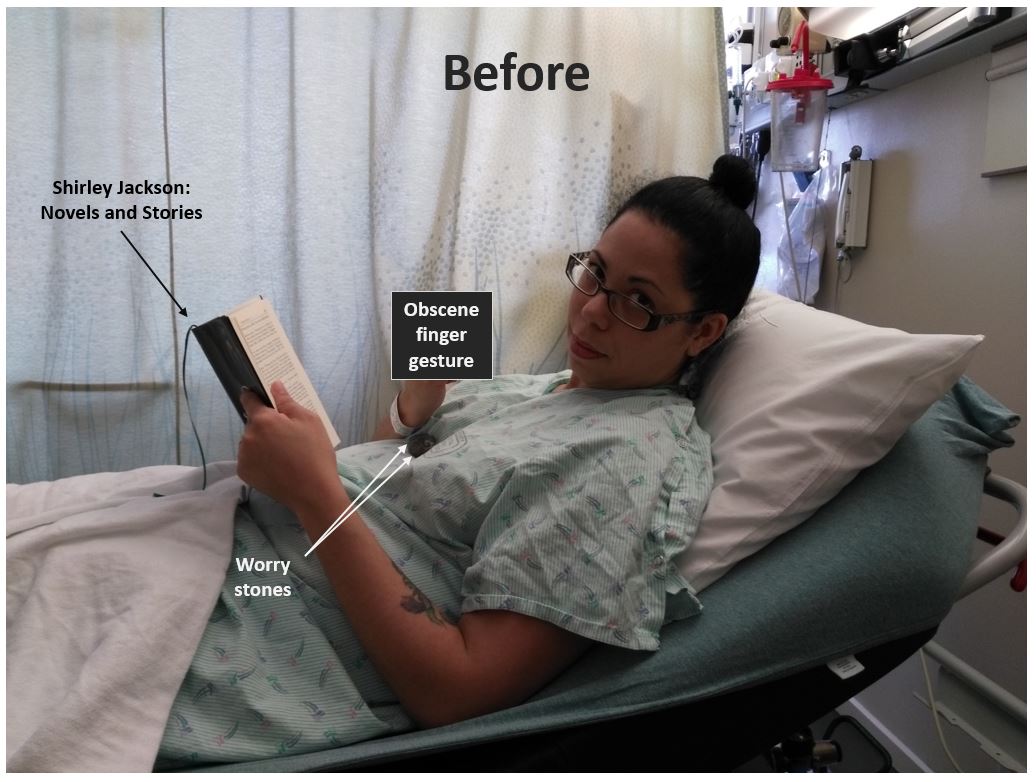
The author in a pre-surgery hospital bed

The intake process went just slowly enough that I was happy I’d brought a book, but quickly enough that I didn’t make much progress. Multiple times I was asked to confirm which procedure I was having and whether I was leaving the hospital that afternoon. I knew from previous surgical procedures that all the repeated questions were safety precautions, checks to make sure everyone was on the same page, but they’d always made me nervous.

I asked for sedatives. I got them. I got sleepy.

And then I was waking up.

People were smiling. I was told that I’d been trying to make jokes. It’s the “trying” that concerns me. My humor is questionable when I’m wide awake; there’s no telling what I think is funny when I’m half out of it, but people were smiling so I’ll take that as a good sign.

One of the doctors asked me if I was feeling any pain. I said that I had some cramps and he pushed a magical little button and the pain went away almost immediately. I must make it clear, though, that the cramping wasn’t bad in the first place. The day after the surgery, a friend asked me if the procedure hurt or if I was in any current pain and I replied honestly that at no point did I suffer worse than I do with second or third day menstrual cramps. All women are different, and I don’t know if my statement is one of how bad my monthly cramps are or of how painless the procedure was, but there you have it.

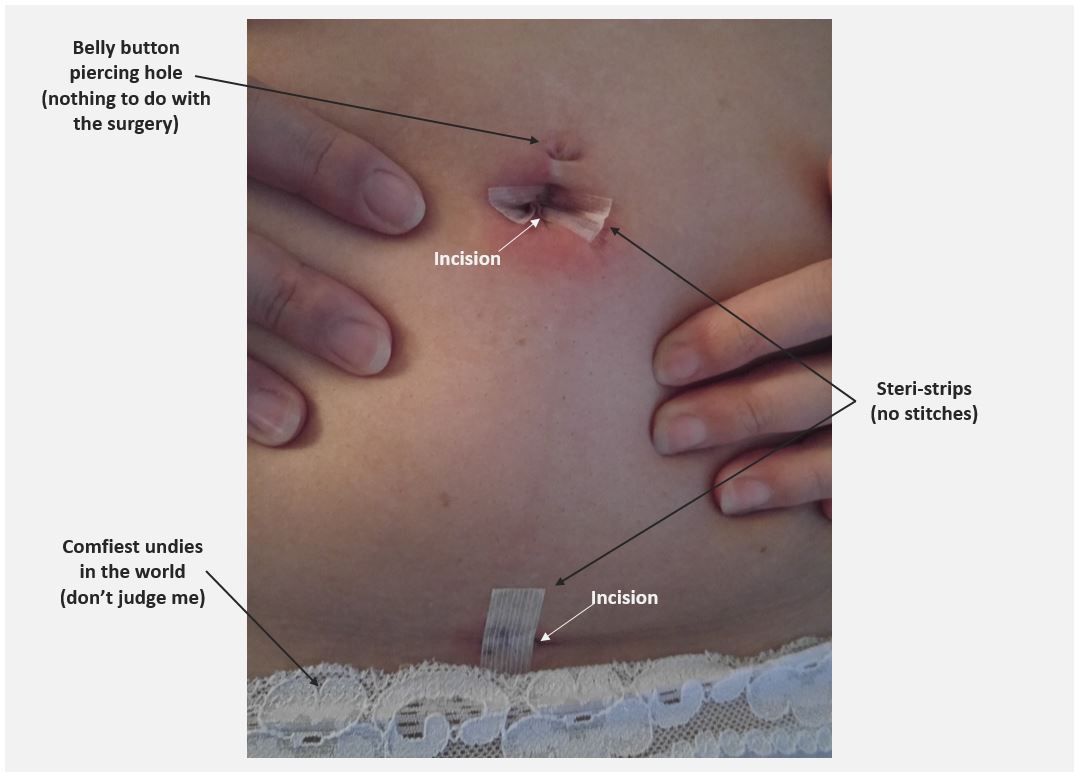
I was left with one tiny little incision in my belly button, and an even smaller one a few inches below.

Close up of the author's very small incisions

While the doctors and nurses were all great (really, they’re angels in my eyes for finally doing this for me), I was especially touched by the nurse who took my hand and told me that she, too, had made the decision not to have kids and that she never regretted it a day in her life. It was like this special moment of solidarity, validating that our choices belong to us and we’re not any less women for making them. We can still be goddesses without being mothers.

I was told not to do any intense workouts or heavy lifting for a week after the surgery and not to have sex until cleared for it in the post op appointment (about two and half weeks after surgery), and that was it. I left the hospital with a weight lifted off my shoulders and a pocket full of pain prescriptions.

It was going to be a good weekend.

I returned to work on Monday.

Was it worth it?

At the time of this writing, I’m only a few days removed from the surgery. Gauze pads have given way to Teenage Mutant Ninja Turtle Band-Aids. I’m not in any pain, even without pain meds, and I’ve got the tell-tale itching of wounds beginning to heal. Little in my life has changed. I’m still child free by choice, only now I don’t really have to think about it. Once I am cleared for sexual activity and I get over shuddering at the thought of unprotected sex (yes, even in my monogamous marriage), I predict that I will enjoy a lot more spontaneity and passion in my sex life now that the once ever-present fear of pregnancy has been removed. The truth is, I have never felt this free in my life and my only regret is not having this done years ago.

But like I said, I wasn’t allowed to make that choice then.

*Tubal ligation does not protect against STDs.

On the Importance of Strong Female Characters

Protest sign: Strong female character

Strong female character

I was fortunate enough to attend the Women’s March on Seattle, a sister to the Women’s March on Washington DC. Before I lose you, I have no intention of talking politics in this post. What I am going to talk about is something I can’t believe is still controversial: the importance of strong female characters in fiction.

As I marched with 175,000 other humans (the estimate at the time of this writing), I noticed countless signs referencing some of my favorite female badasses from fiction. I took in multiple nods to space rebels, vampire slayers, and warrior princesses and knew—without a doubt—that every last person who argues that female heroes aren’t interesting or “won’t sell” is absolutely full of shit. I saw little girls in Wonder Woman costumes and Princess/General Leia t-shirts (I was wearing a General Leia shirt myself), and knew—without a doubt—that the strong female characters we see on screen and read about in books really do have an impact on us and how we view ourselves, each other, and our roles in the world around us.

What would General Leia do?

Star Wars themed protest signs

The Force is strong and so are we.

These three signs caught my attention, but you couldn’t swing a pink pussy hat without hitting a Leia Organa reference. Considering that Carrie Fisher was a badass in real life, this is not surprising. If the dead really do get to hang around and see what the living are up to, I’d like to think that she got a giggle from the “Carrie Fisher sent us” sign.

I’d like to think that she’d be proud to be our rebel leader.

Are you ready to be strong?

sfc-pic-2

Fans of Buffy: the Vampire Slayer not only know where the words on this sign come from, but many of us can recite the entire speech—if we can get through it without crying, that is. Submitted for your misty-eyed pleasure:

For people like me who rarely view embedded videos in an article, here are the highlights:

They were powerful men. This woman is more powerful than all of them combined. So I say we change the rule. I say my power should be our power…From now on every girl in the world who might be a slayer, will be a slayer. Every girl who could have the power, will have the power. Can stand up, will stand up. Slayers, every one of us. Make your choice. Are you ready to be strong?

-Buffy Summers

A whole damn lot of us made our choice and are ready to be strong.

And then there’s this:

sfc-pic-3

The picture says it all.

Xena will always have a special place in my heart. It was a Xena poster I hung on my wall to remind me not to take any shit, particularly from real-life Joxers.

I’ll never forget the time I told a guy that I was a big Xena: Warrior Princess fan and he responded, “You know Xena and Gabrielle are lesbian icons, right?” Well, I hadn’t actually known (naïve me, I guess), but the only troubling thing about finding out was this guy’s tone and his obvious suggestion that there was something shameful about being a lesbian icon. Fuck that noise.

So here’s the thing…

The articles reminding us that one march isn’t enough are already flooding my feeds—as well they should. Marching is great, but there is more work to be done. There are the things we can all do as citizens; then there are the things we can do that are more personal.

I’ve always known that the presence of strong female characters in fiction is important, but this march solidified for me what a great female character can inspire in real life women. As a result, my dedication to writing these characters has been renewed. I intend to contribute as many badass women to the fiction world as I can because…well…I can. And of course, I don’t want to do it in some pandering political way—obvious and boring as hell to read—but in a way that’s honest. A way that inspires.

I suppose I can call it my duty. I prefer to call it my privilege.